Photo via Fast Company
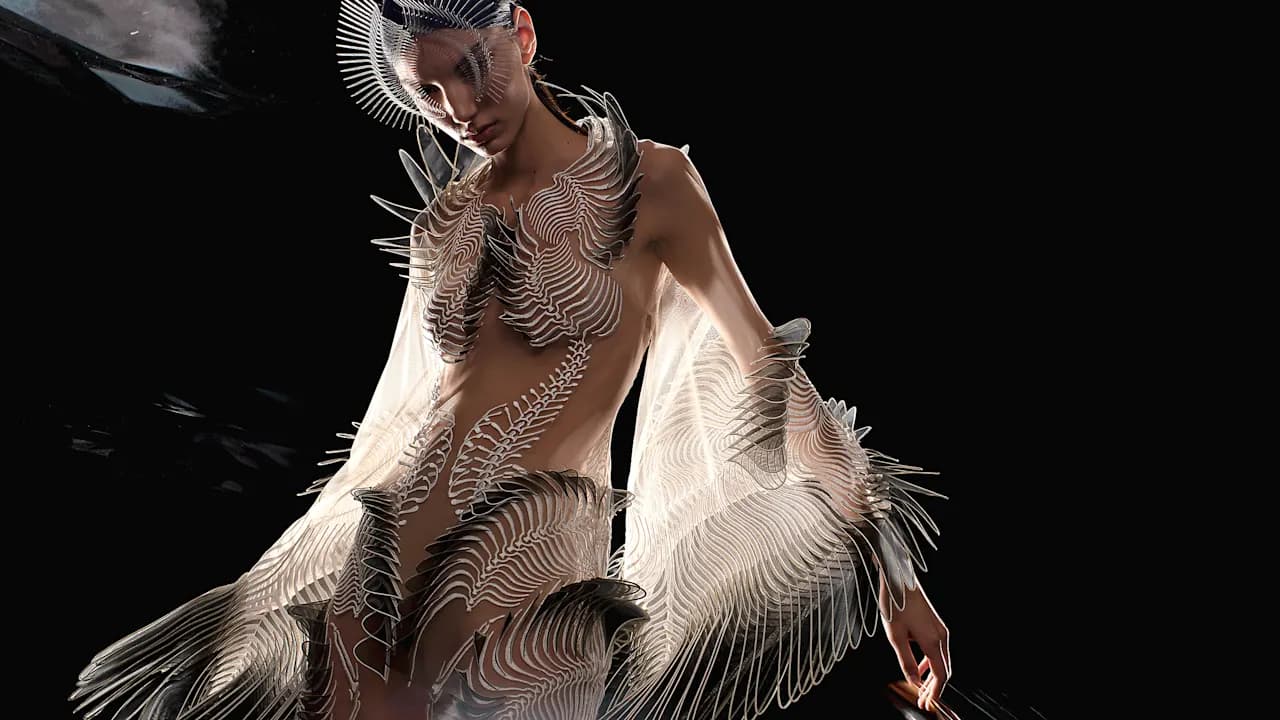
In an industry churning out 92-100 million tons of textile waste annually, one designer is charting a starkly different course. Iris van Herpen, a Dutch couturier gaining international recognition, has built a two-decade career treating science as a creative partner rather than a constraint. Her work—from garments incorporating bioluminescent algae to pieces inspired by ichthyosaur skeletons—demonstrates that luxury fashion can prioritize craft, sustainability, and intellectual rigor over rapid production cycles. According to Fast Company, van Herpen's upcoming retrospective at the Brooklyn Museum, opening May 16, positions her as a pivotal figure in redefining what fashion can achieve when designers collaborate with biologists, architects, and paleontologists.
Van Herpen's commitment to couture-only production represents a deliberate rejection of contemporary retail trends. While the fashion industry increasingly relies on AI-generated lookbooks and ultrafast inventory turnover—exemplified by brands like Shein—van Herpen produces limited pieces entirely by hand, often requiring thousands of hours per garment. Her 2010 Crystallization collection featured the fashion industry's first 3D-printed runway garment, created in partnership with British architect Daniel Widrig. This willingness to experiment with emerging technologies while maintaining handcrafted production offers a counterintuitive model: innovation need not mean volume.
The sustainability angle sets van Herpen apart in a market increasingly pressured to address environmental impact. She has experimented with recycled ocean plastic, 3D-printed cocoa beans, and last year unveiled a 'living dress' seeded with 125 million bioluminescent organisms. Rather than viewing materials as commodities, her atelier studies natural structures—fish scales, spider webs, coral systems—then translates those architectures into novel textiles. This biomimicry approach suggests that haute couture's intensive labor model, often criticized as wasteful, may paradoxically be more sustainable than mass production when paired with regenerative material research.
For Charlotte's retail and luxury sectors, van Herpen's model raises strategic questions about differentiation and value creation. As discount retailers dominate consumer attention, high-end brands increasingly compete on storytelling, provenance, and intellectual property rather than price. Van Herpen's approach—documented in her Brooklyn Museum exhibition through video installations showing real-time atelier work—makes the manufacturing process itself the product narrative. This emphasis on slow production, scientific collaboration, and material innovation offers an alternative positioning strategy for luxury retailers seeking to justify premium pricing and build customer loyalty in an oversaturated market.